
Key Takeaways
- Your ad doesn’t interrupt the answer — it becomes part of it. ChatGPT Ads appear below the response, clearly labeled “Sponsored,” only when there’s a genuine contextual match.
- Forget keywords. The system reads the entire conversation. ChatGPT understands tone, context, and the real problem behind the query — not just the words typed. “I have thermal discomfort” triggers the same intent as “I need shorts.” That’s Natural Language Understanding, not keyword matching.
- Ads only trigger when a real need is detected. Someone asking about cooking won’t see travel ads. The system scores intent strength in real time — a direct need fires the ad, a casual mention doesn’t. That’s need-based activation, not impression-based guessing.
- The platform classifies exactly where someone is in their journey. Buying, learning, or comparing — ChatGPT figures it out from the conversation itself and serves the right ad at the right stage.
- Privacy isn’t just a promise — it’s built into the design. Conversations are never sold to advertisers. Personalization is optional. Sensitive topics like health and politics are fully blocked from ads. The system is designed to protect users first, monetize second.
The Shift to AI-driven Advertising
Advertisements are live into AI Assistants, where people ask questions instead of typing keywords. For marketers, this fundamentally changes everything about how we connect with people. If you want to advertise in ChatGPT, you should know how ChatGPT Ads will work?
Traditional ads are heavily reliant on keywords and clicks. AI-driven Ads live in conversational AI interfaces. When someone ask question on AI Assistants, your brand appears as an answer itself, rather than intrusive Ads on the sidebar. In short, your Ad becomes part of the dialogue.
Core Principles behind ChatGPT Ads design.
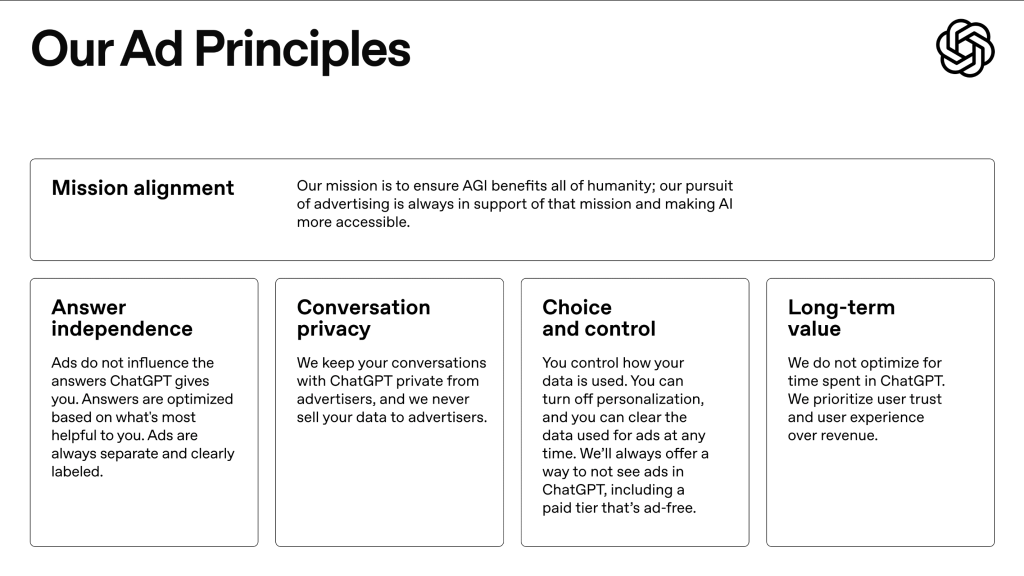
Image Credit: OpenAI
- Conversation Privacy: ChatGPT claims that it’ll keep conversations private by not selling data to advertisers (Privacy Policy).
- Answer Independence: Ads do not influence the answer. Ads will be optimized based on what’s most useful to you and will clearly be labeled sponsored.
- Choice and Control: Users can control how their data is used. They can turn off personalization when they want, and more generic ads will be shown instead of personalized ones.
- Long-term value: They want to be your super assistant for long-term value rather than an addictive feed that wants you to stay on the app as long as possible.
How ChatGPT Ads target users: Intent and Context (Targeting logic)
Conversational VS Keyword Targeting.
Traditional Search is often linear: You type “shorts for men” (Keyword) and get a full list of results (stores). However, ChatGPT operates on Natural Language Understanding (NLU) by understanding the actual problem behind the query.
Scenario: If a user types, “I have thermal discomfort, and I want to look more casual and free, so recommend me shorts according to that”. Here, AI recognizes the intent as “thermal discomfort + Casual and free.”
Role of User Intent
The true strength of ChatGPT Ads is it lies in contextual intent targeting. Traditional Ads rely on Cookies, keyboards, and demographics. However, ChatGPT operates on natural language and conversation.
This means the platform understands that what a user wants/means. If someone spends 10 minutes comparing Samsung, then ask about the ecosystem of Apple. ChatGPT has concluded a genuine intent to purchase.
Targeting Signals Used
ChatGPT will target Ads based on what’s happening in real time; the topic of the current conversation and what the user is asking about right now.
However, Personalization signals are optional; users can opt out if they prefer.
Mechanics: How ChatGPT determines what to show?
Conversational Analysis & Relevance Scoring
The AI assistant’s language model analyzes what the user is asking (their exact words, tone & conversational context) to score how relevant your Ad is to that moment. High relevance means it matches what the user is asking for and your Ad appears; low relevance means it stays hidden. It’s a real-time matching, not pre-programmed rules.
Trigger Conditions
Ads will only be shown when the system detects an actual need. If someone asks about booking a Yacht, the travel Ads trigger. If they’re asking about cooking, travel ads don’t show. It is based on need-based activation rather than impression-based tracking.
Intent Classification
ChatGPT will classify the intent as either the user wants to buy, learn, or compare. For this, ChaGPT use nuanced understanding of the user stage according to the situation, not just keywords.
Placement: Where & How ChatGPT Ads Appear
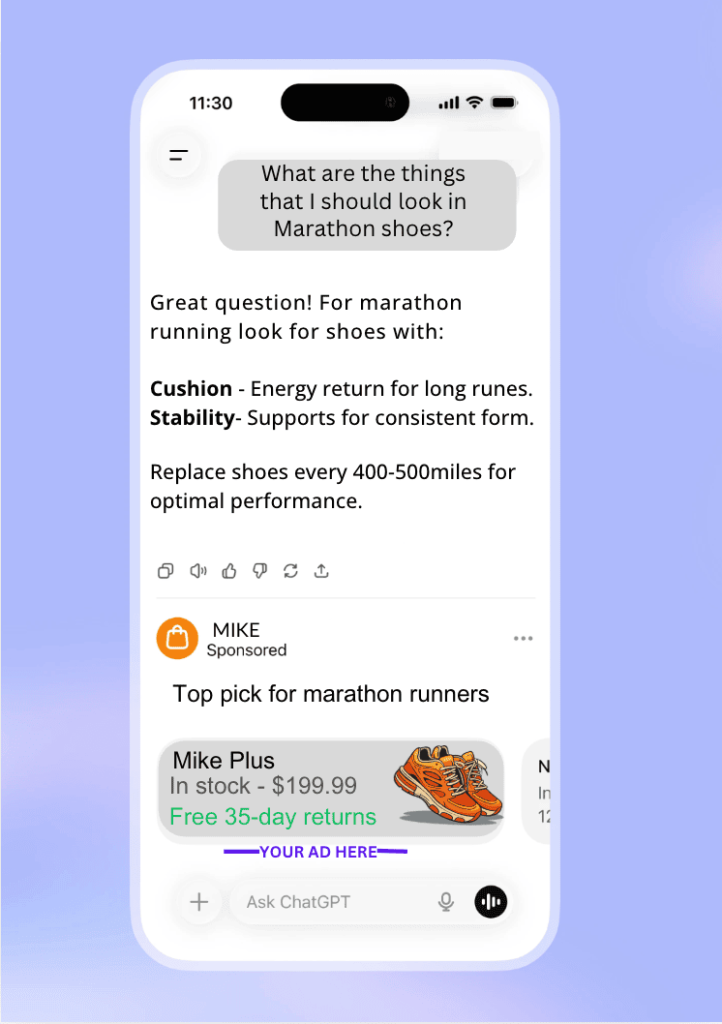
Ads appear after the original answer and are clearly labeled as sponsored. And do not interrupt the ChatGPT responses. They’re designed as helpful suggestion not just interruptions.
LLM Design Logic: How large models decide what to show.
Semantic Understanding VS Keyword Matching
Large Language Models (LLM) use deep context to understand meaning-they don’t just hunt keywords.
For instance, if someone asks, “ Where should I go in winter?” The system grasps that they mean travel, not just the word “go” appeared. This deep contextual understanding weighs relevance far more accurately than old-school keyword matching ever could.
Intent Weighting and Response Priority
Before an ad runs, the system scores how urgent and clear the user’s need actually is. A direct query like “I need to upgrade my laptop” scores high. A casual mention like “laptops are becoming better day by day” scores low. The model weighs intent strength to decide if an ad should appear at all, or if it should prioritize information answer instead.
Model Constraints (privacy and sensitivity Filters)
The system has built in guardrails that surpass ads for sensitive topics – health, politics, and mental health. These filters protect users from exploitative targeting while ensuring ads only appear in an appropriate context.
Conclusion: The New Landscape of AI Advertising
ChatGPT Ads work differently from the ground up. Ads trigger on real-time conversational context, not keyword bids.
For marketers, this means shifting from keyboard strategy to intent strategy. You’re no longer competing for keyboards – you’re competing on whether you product genuinely solves what someone is asking right now.
Frequently Asked Questions
Testing officially began on February 9, 2026. Currently, ads are limited to logged-in adults in the United States. A broader rollout to Europe and Asia is expected by Q2 2026.
Ads are shown to logged in users on free and new ChatGPT Go ($5-10 per month) tiers.
Ads will appear below ChatGPT’s response as clearly labeled sponsored.
The interference remains clean. Open AI has clearly stated that they’ll not “force” random ads if there is no contextual Ads.