
Key Takeaways
- ChatGPT Ads are already live. OpenAI started testing sponsored content in February 2026 — shown right after ChatGPT responses, clearly labeled “Sponsored.”
- Forget keywords. Context is the new targeting. Unlike Google or Meta, ChatGPT Ads target users based on what they’re actively asking — making your ad relevant to the exact problem they’re solving right now.
- The cost is high, but so is the intent. At ~$60 CPM, it’s triple the average Meta cost. But you’re reaching someone who is already in decision mode — not just scrolling.
- Early movers always win. The platform is fresh, competition is thin. Businesses that get in now will acquire customers at a fraction of what others will pay six months from now.
- If AI can’t understand your business, it won’t recommend it. Define clearly who you are, what you do, and who you serve — paid or organic, that’s what gets you recommended.
What are ChatGPT Ads?
ChatGPT Ads are paid advertising campaigns, managed by OpenAI (parent company of ChatGPT), that allow businesses to target their potential customers by showing sponsored content after ChatGPT responses. These ads utilize Context, Intent, and conversational data to target potential customers moving from traditional search or social behaviour.
Current status of ChatGPT Ads
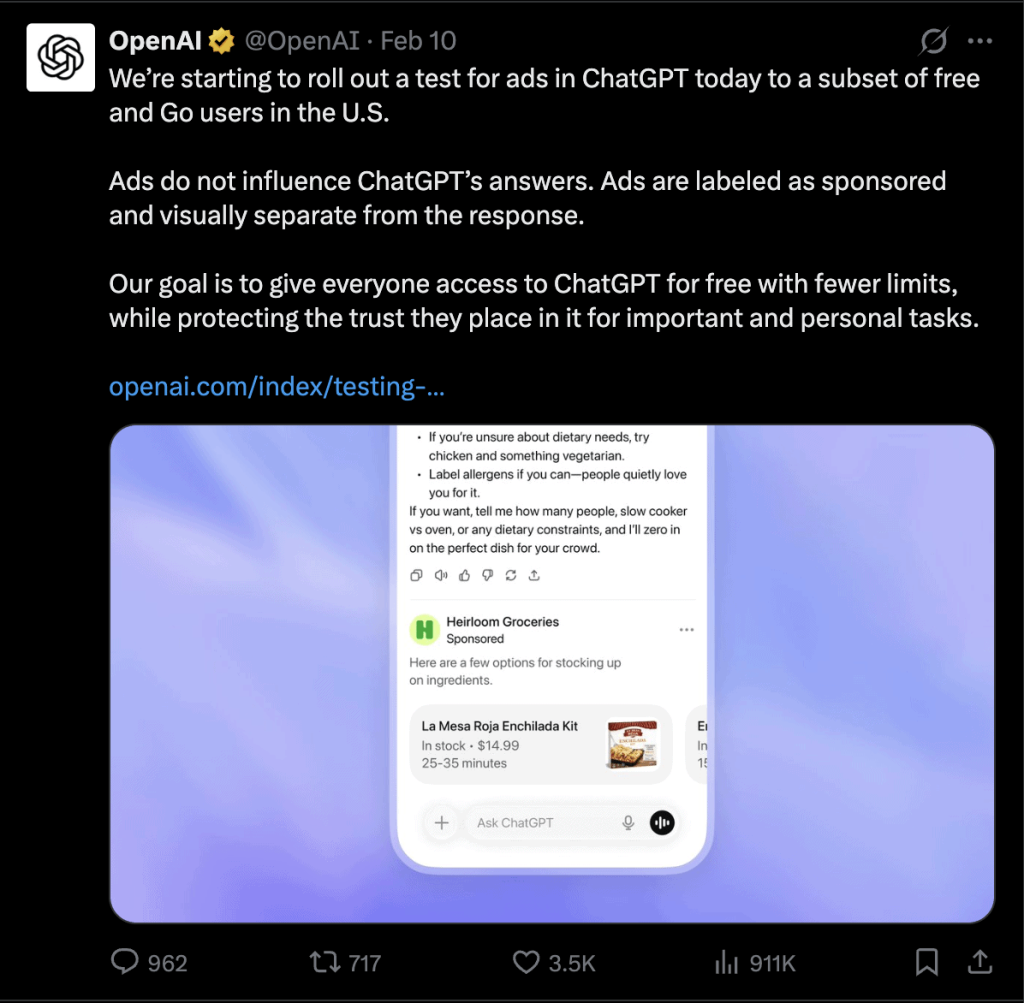
Ads are live as of February 2026 as testing phase for selected business, making a major shift of the company from subscription-based to ad revenue.
Tip: if you’re a businessperson/entrepreneur who is looking to advertise on ChatGPT, then start preparing by ranking organically for credibility, and make sure the brand is also a part of the answer rather than an interruptive ad.
How ChatGPT Advertising will work (Testing phase)?
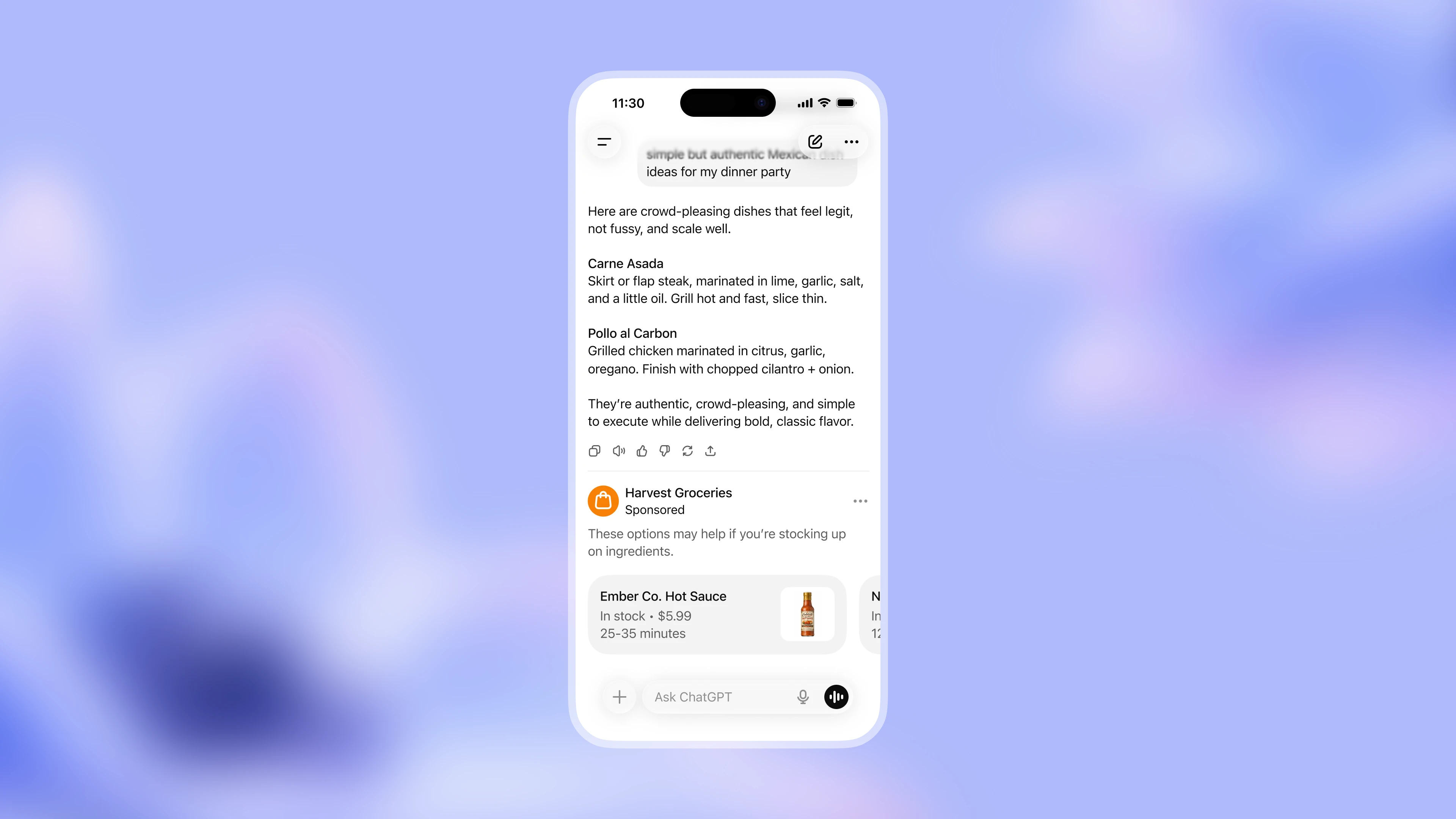
According to reports, Ads will be shown after the responses without disturbing the original answer. The ads themselves will be contextual and relevant to the user query.
How will AI Advertising be different from Google and Facebook’s?
The 2026 advertising landscape has shifted from the official rollout of ChatGPT Ads. Also, AI advertising will be totally distinct from Google and Meta Ads:
Targeting logic
Google Ads: Keywords, content, and audiences
Meta Ads: Audience demographics and behaviours
ChatGPT Ads: Contextual (based on current query/conversation)
Reporting and Cost Variants
Google Ads: Cost per Click(CPC) or Cost Per Action(CPA)
Meta Ads: Primarily Cost per Mile(CPM)
ChatGPT Ads: High-Tier CPM ( rumours 60$ per 1000 impressions)
Why Advertise on ChatGPT?
People come to ChatGPT not just to ask questions, but to decide what to do next, what to buy, where to go, and which option to choose.
For that reason, ChatGPT knows everything about you, from what profession you are in to how you are feeling right now. This makes ChatGPT ads super relevant to the problem they are dealing with. Here are a few tweaks that help you to better understand the importance of ChatGPT Ads:
High Intent discovery
When a user finds a product that perfectly matches what they are looking for according to their personal preferences, they’re more likely to convert. Simply, it focuses on delivering personalized ads to the customers, showing a high likelihood of purchasing or needing a solution.
Conversational Commerce
Instead of pop-up ads breaking your focus, Ads appear as a logical texted step to solve a problem. In short, it moves away from “shouting” at users (interruptive) to advertise them (contextual).
For instance, if a user asks, “Help me choose a tool for LinkedIn”, the ad look like a one-tool suggestion below the answer rather than a separate panel.
Early Adoption Advantage
Getting in early on ChatGPT Ads is a massive opportunity. Because the platform is fresh and the competition is thin. So you can snag customers for a fraction of the cost that others will be paying later on.
This personal, conversational approach of ChatGPT Ads builds way more trust and turns one-time clicks into a loyal fan base before your competitors even realize.
How ChatGPT Ads will be different from Traditional Ads.
ChatGPT ads represent a traditional interruption-based advertising to conversational, intent-driven, and context-based recommendations.
Trigger event
The Ads on ChatGPT are triggered by conversation/chat itself rather than Keywords or interests and behaviours that Google and Meta use.
Scenario: If a user asks for a trekking guide, AI suggests ideal hiking shoes right in the flow of conversation. Instead of an annoying interruption, your brand becomes more memorable and relevant.
User Intent Capture
ChatGPT Ads capture intent through analyzing whole conversations rather than whole keywords.
Scenario: if a user gives a prompt, “Dinner party menu for vegans,” then AI will give the answer of the whole recipe and shopping list. And in Ad, there will be a link of plant based meal or grocery delivery.
Ad formatting and Labeling
The Ad formatting of ChatGPT Ads are completely different from Google and Meta Ads. Rather than disturbing answers, Ads appear at the bottom of the conversation and will be clearly labeled Sponsored.
Pricing Model
Reports suggesting that the starting pricing model will be based on Cost Per Mile (CPM) (60$ per 1000 impressions), which is triple of what average cost on Meta for Advertising.
Future Potential of AI-driven Advertising.
The future potential of AI relies on hyper-personalization and autonomous optimization. With Ads in ChatGPT, it’s a clear sign that more LLM models will do the same in the near future.
Next Gen Ad formats
OpenAI revealed that ads will be at the bottom of the conversation with clearly labeled sponsored. However, in the coming future, they will definitely go with product carousels and interactive chat adverts cause the potential is high.
Integration of AEO (Answer Engine Optimization)
While AEO earns organic “mentions” within answers, paid ads provide immediate, high-intent visibility alongside those trustworthy responses.
Privacy Ethics and Regulation
People have started using ChatGPT as their personal therapist; however, rolling out ChatGPT ads has made them concerned about the data that they have shared with ChatGPT.
Privacy Guidelines
OpenAI clearly states that conversations will never sold to advertisers, and users will have the right to stop personalized ads; ads won’t disappear, but ads become more generic.
Sensitive Context and Safety
OpenAI clearly states that topics under health, politics, and mental health are not eligible of ads. Also, there will be no testing of Ads for under 18.
How to prepare for ChatGPT Advertising
OpenAI has started to test ads in the United States for Free and Go tiers, with paid subscriptions (plus, pro, enterprise) remaining ad-free.
Businesses that start preparing today will have a massive advantage when the official rollout of ChatGPT Ads for all businesses.
Fix these 4 things
- Clear Category definition (Who you are + What you serve)
- Tight service Descriptions ( use plain English, bullet points, and Active voices to remove fiction)
- Proof Signals (reviews, Case studies, Comparisons, Testimonials)
- Location + Specialization: Clearly stated everywhere.
(If ChatGPT cannot understand your business itself, it can’t recommend it either paid or organic.)
Start Training Clients on Recommendation Thinking
Future conversions won’t be about “what keywords do you want to rank for?” It will be about “when someone asks an AI to hire you, what makes you become their first recommendation?” or “Why should it be you?”
You should start asking your existing Ideal Customer Profile (ICP) these questions.
- What are you basically best at?
- Who are you not for?
- What makes you safer, faster, cheaper, and better?
Prepare for fewer clicks, high intent
It means you should prioritize quality over quantity. Ensuring what users need exactly to boost conversation rates.
Common mistakes to avoid

As ChatGPT begins testing sponsored (Ad) content in the coming weeks, many advertisers will make mistakes by treating it like a search engine playbook. Here are a few common mistakes that you should avoid:
- Ignoring privacy boundaries
OpenAI clearly states that there will be no ads shown under topic-sensitive or regulated topics like mental health, health, and politics.
2. Treating it like a Google search
Unlike Google, where ads compete for a click, ChatGPT Ads appear after the answer is given. A mistake is failing to offer a ‘next best step” (e.g., demo, free trial) that matches someone who has already received a recommendation.
3. Generic Copy
In the Chat environment, generic “buy now” feels interruptive and irrelevant. Successful ads must solve the problem that they’re facing rather than sales stuff.
4. Targeting the wrong tier
No ads shown to ChatGPT Plus, Pro, or enterprise users. Aiming for high-value spenders who typically pay for ad-free tiers could lead to lower than expected conversation rates.
5.Neglecting Answer Engine Optimization (AEO)
A common pitfall is running ads for a brand that AI organically hates or doesn’t know. If AI’s main response gives a negative comparison of your product, a sponsored link below won’t convert.
Conclusion
ChatGPT Ads are expected to change how we see paid ads, from annoying pop-ups to meaningful suggestions. While the system is in testing phase, businesses can prepare now by clearly explaining who they are. What do they do? And whom do they serve?
It is a sign that in the future, Ads will feel more like useful advice than a sales pitch. Companies that focus on being easy to understand and being truly helpful in what they do have the best chance on success when ChatGPT Ads become available.
Frequently Asked Questions
There is no official statement on OpenAI’s platform for previews/testing phase for advertisers. As of now, they’re testing the Ads model with business who have the ad budget of $200k.
Yes, by default, but users can disable ad personalization in settings. If disabled, ads will only be based on the context of the current active conversation.
Yes. Users can dismiss ads, hide them, and click an “info” icon to see why a specific ad was shown.
Unlike Google, where you must click away to a site, OpenAI is testing Instant Checkout allowing users to buy an advertised product directly within the ChatGPT interface