
Key Takeaways
- People have stopped Googling — they’re now conversating. Users are asking follow-up questions, exploring nuances, and making full decisions inside one ChatGPT chat.
- The businesses winning early all share one trait. SaaS, local services, real estate, e-commerce, and professional services — they all solve specific problems that require trust and expertise. If your business does the same, ChatGPT Ads are built for you.
- High-intent users convert faster. ChatGPT users aren’t passively scrolling — they’re actively problem-solving. When your ad shows up at that moment, you’re not interrupting them. You’re answering them.
- Credibility isn’t optional — it’s the entry ticket. AI recommends trusted sources first. Reviews, brand mentions, and authoritative content determine whether your ad even gets shown. Build that before you spend a dollar.
- Frictionless offers win every time. Free trials, instant booking, free consultations — when a high-intent user is ready to move, the business with the lowest barrier to entry gets the conversion. Make it easy, or lose it.
Why ChatGPT Ads matter for business growth?
For nearly two decades, Google search has been the default engine for business. Someone has a problem, they type in Google, and ads appear on results.
But user behaviour is shifting. From last couple of years, people have started conversations in ChatGPT instead of typing a query on Google. They’re asking follow-up questions, exploring nuances, and making decisions within one chat without bouncing between search results and websites.
ChatGPT Ads matter the most for business growth because they capture users during active problem-solving. Unlike Google or Passive Meta scrollers, ChatGPT users are high-intent and engaged. Most importantly, ads appear in perfect contextual relevance. If someone discusses about back pain, your ergonomic solution appears naturally within their thinking process.
How ChatGPT Ads deliver value to customers?
On ChatGPT, users are already in “Problem-solving mode”. They type in a detailed prompt and expect detail relevant answers. So, ChatGPT knows what problem the user is facing to what type of solution they want. And ads appear only when relevance and intent align with the sponsored result.
Top Industry Use Cases of ChatGPT Ads. (Business-specific)
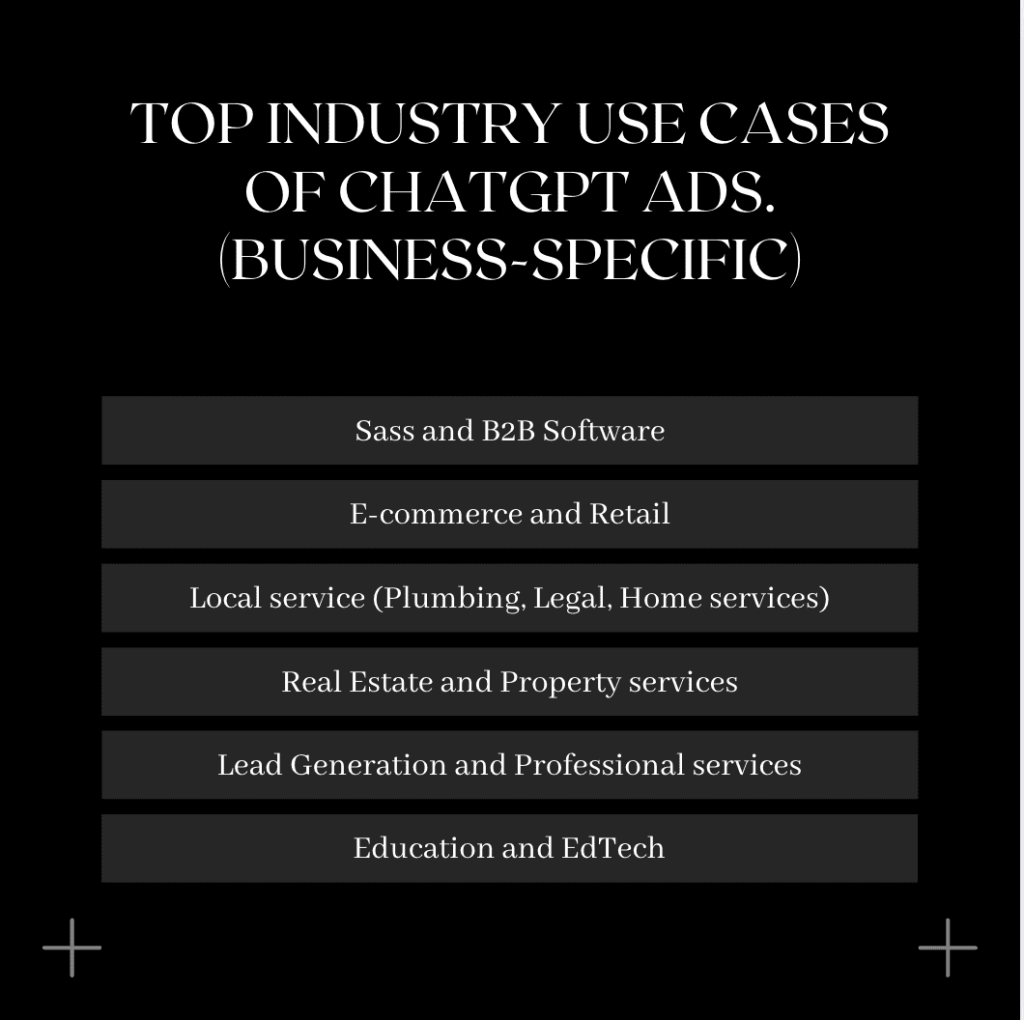
SaaS and B2B software
ChatGPT users frequently ask for software comparisons, demos, pricing, and integrations. Plus, when people are confused on which service to choose, ChatGPT ads can guide them through direct consult session links or Ads for free trials, because intent is high in the research phase.
E-commerce and Retail
ChatGPT users ask for product recommendations when they’re on research phase (best wireless earbuds under $100). Here, ChatGPT can recommend sponsored products within conversational shopping queries. Now, ChatGPT has opportunity to drive conversations in real-time purchase intent.
Local Service (Plumbing, legal, Home services)
People also use ChatGPT for local queries, “best (service) near me.” For specific service suggestions. When customers’ immediate needs match what they’re looking for, they’re likely to convert, which generates strong Return On Investment (ROI).
Real Estate and Property Services
Real estate decisions involve high stakes, trust, and local expertise. When people ask about local markets, agent recommendations, and investment tips on ChatGPT: Conversations where credibility and local knowledge matter the most. Here, ads are positioned as expert recommendations to convert high-value leads.
Lead Generation and Professional Services
Professional service buyers who are looking for lawyers, financial advisors, and consultants seek expertise before committing. They ask for recommendations, advice, reviews, and vetting criteria to confirm before taking services. At the moment, ChatGPT Ads are positioned as expert suggestions (not hard sells) to capture high-intent leads who are actively evaluating solutions.
Education and EdTech
Education buyers ask for program recommendations, course and its cost comparisons, and certification guidance; these are the conversations where outcomes and fit matter the most. At this time, ChatGPT Ads are positioned as personalized learning recommendations to capture those who are actively evaluating options.
Preparing your Business for ChatGPT Success
To win with ChatGPT Ads, you need these 4 things first:
- Answering real question to the people about what they’re asking on Chat, not generic marketing.
- Build credibility through reviews and brand mentions: cause AI recommends and prioritizes trusted sources.
- Make offers frictionless (free trials, instant booking, free consultation) so high-intent users convert immediately.
- Show up in both paid Ads and Organic ChatGPT recommendations by having strong content and reviews.
Future Outlook

ChatGPT ads represent a fundamental shift in how businesses reach customers. Unlike Google’s interruption-based model or Meta’s passive scrolling, ChatGPT captures users mid-conversation, mid-thought, mid-decision. This isn’t a replacement for existing channels—it’s a new tier of the funnel where high-intent, engaged users actively seek solutions.
The businesses winning early—SaaS, local services, real estate, professional services—share one trait: they solve specific problems requiring trust and expertise. As the platform matures, expect more verticals to emerge. But the core advantage remains: contextual relevance meets engaged attention.
For sustainable growth, businesses need credibility first (reviews, authority), then tactical offers (free trials, demos), then paid presence. ChatGPT ads reward preparation, not shortcuts.
Frequently Asked Questions
It is a combination of both. OpenAI is projected to lose $14 billion in 2026 due to massive infrastructure and compute costs. Strategically, ads allow OpenAI to keep a “Free” tier viable for its 800 million weekly users while targeting a $25 billion ad revenue goal by 2029.
Current beta testing focuses on Travel, Retail, and Technology (e.g., “best laptops,” “hotels in NYC”). Prohibited categories include health, politics, and mental health.
Sam Altman argues that ads support the mission by keeping AI accessible to everyone, regardless of their ability to pay $20/month.